
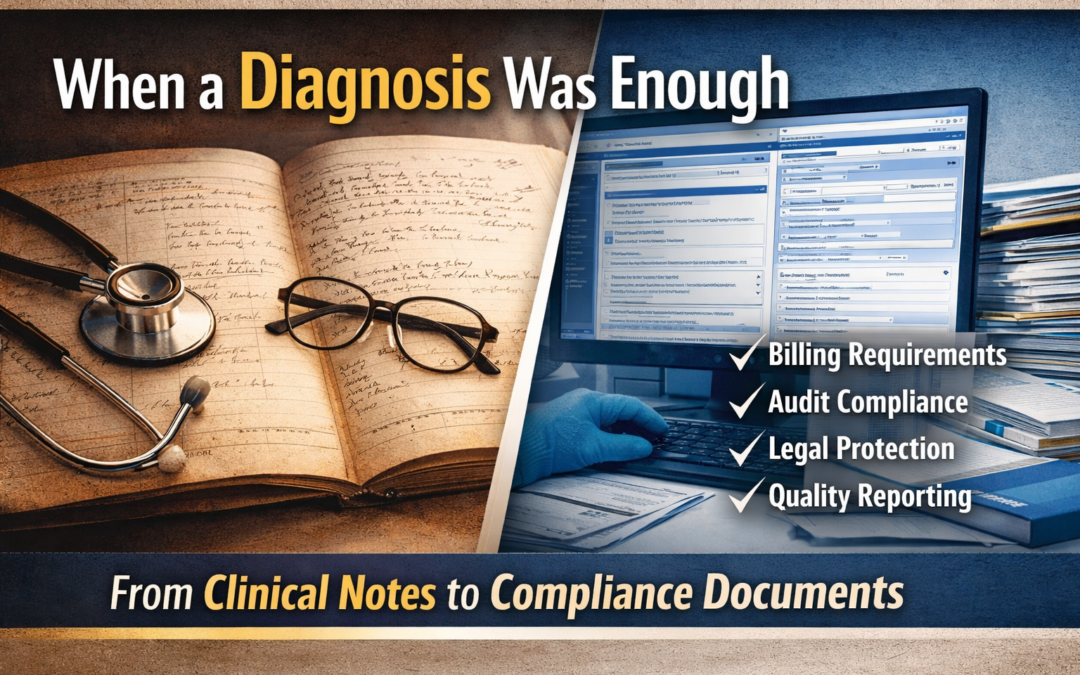
How Medical Documentation Expanded Beyond Clinical Need
There was a time when a diagnosis name carried weight.
When a physician documented myocardial infarction, appendicitis, pneumonia, or cholecystectomy, it was not merely a label. It was a precise clinical conclusion derived from training, examination, reasoning, and experience. Disease and procedure nomenclature were created to summarize complex pathology into meaningful, standardized medical language. Healthcare providers are licensed and trained to use these terms accurately.
In principle, a well documented set of relevant positive and negative findings, followed by a clear diagnosis and plan, should be sufficient to convey the patient story.
Yet today, medical records often span multiple pages. Templates auto populate extensive review of systems. Physical examinations list normal findings across organ systems unrelated to the presenting complaint. Notes are copied forward, expanded, and layered with compliance language.
What happened?
The Original Purpose of Medical Records
Historically, documentation served one primary audience: another clinician.
A typical record contained:
- Chief complaint
- Pertinent positives
- Relevant negatives
- Assessment
- Plan
The focus was clinical reasoning. Brevity was not negligence. It was efficiency. Disease names were designed to communicate precisely what was wrong, how severe it was, and what intervention was required.
Documentation supported patient care. Nothing more.
The Insurance Era Changed the Function of Documentation
The transformation began when healthcare financing evolved.
With the expansion of structured reimbursement systems under organizations such as the Centers for Medicare & Medicaid Services, documentation became tied directly to payment. Standardized coding systems such as those maintained by the World Health Organization and procedural coding frameworks from the American Medical Association formalized how services were reported and reimbursed.
The medical record was no longer just a clinical communication tool. It became:
- A billing document
- A compliance instrument
- A legal defense record
Payment now required proof. And proof required detail.
The Bullet Counting Era
The publication of the 1995 and 1997 Evaluation and Management documentation guidelines institutionalized structured documentation requirements.
Instead of writing what was clinically essential, providers were encouraged to document:
- Extended history elements
- Multi system review
- Specific physical exam components
- Risk stratification elements
Documentation expanded not because medicine demanded it, but because reimbursement validation required it.
The phrase “if it is not documented, it did not happen” became embedded in healthcare culture.
Defensive Medicine and Legal Pressures
Malpractice risk further intensified documentation expansion.
Detailed notes became protective armor. Providers documented extensively to demonstrate thoroughness, decision making, and consideration of alternatives. Even when a diagnosis name communicated the condition clearly, risk management culture favored exhaustive narrative.
Documentation became as much about legal defensibility as about clinical clarity.
Electronic Health Records Amplified the Problem
The arrival of electronic health records was expected to streamline care. Instead, it often increased documentation volume.
Templates enabled:
- Auto generated review of systems
- Pre populated normal examinations
- Copy forward functionality
Notes became longer, not necessarily more meaningful. Redundancy multiplied. The clinical story frequently became buried under templated text.
Technology optimized documentation production, not documentation quality.
Value Based Care and Risk Adjustment
Modern reimbursement models added another layer.
Risk adjustment methodologies require documentation of:
- Chronic conditions
- Disease specificity
- Severity and complications
- Ongoing monitoring
A simple diagnosis label is no longer sufficient. It must be supported by status, assessment, and plan elements that validate coding specificity.
Documentation now serves multiple stakeholders simultaneously:
- Clinicians
- Coders
- Auditors
- Payers
- Regulators
- Attorneys
- Data analysts
The medical record has evolved into a multi purpose artifact.
The Core Tension
At its foundation, medical nomenclature was created to reduce complexity. Disease and procedure names were meant to summarize pathology efficiently.
Modern healthcare systems, however, require documentation to expand complexity in order to justify reimbursement, withstand audits, support quality metrics, and enable data extraction.
Clinically, concise documentation with relevant positives and negatives may be sufficient.
Administratively, it is often not.
This is the central tension of contemporary medical documentation.
Are We Documenting for Patients or for Systems?
Today’s documentation often reflects financial architecture more than clinical necessity.
What began as a tool for communication evolved into:
Clinical note
Legal safeguard
Billing instrument
Compliance report
Quality metric source
Data mining input
Redundancy is not accidental. It is structural.
The Path Forward
The solution is not a return to illegible one line notes. Nor is it endless templated expansion.
The future likely lies in structured, clinically meaningful documentation that captures relevant positives, negatives, assessment, and plan in a standardized format. Such documentation can support reimbursement integrity without overwhelming narrative redundancy.
As healthcare increasingly integrates artificial intelligence, clinical documentation improvement initiatives, and automated coding systems, clarity and structure will matter more than sheer volume.
Perhaps the next evolution of healthcare documentation will restore balance, where a diagnosis once again carries its intended weight, supported by meaningful clinical context rather than excessive repetition.
When that balance is achieved, the medical record may return to its original purpose: telling the patient’s story clearly, accurately, and efficiently.
Author:
Dr. Shyam Sunder
Consultant – Healthcare RCM I CDI I Clinical Coding
Synergy Medical Coding Academy